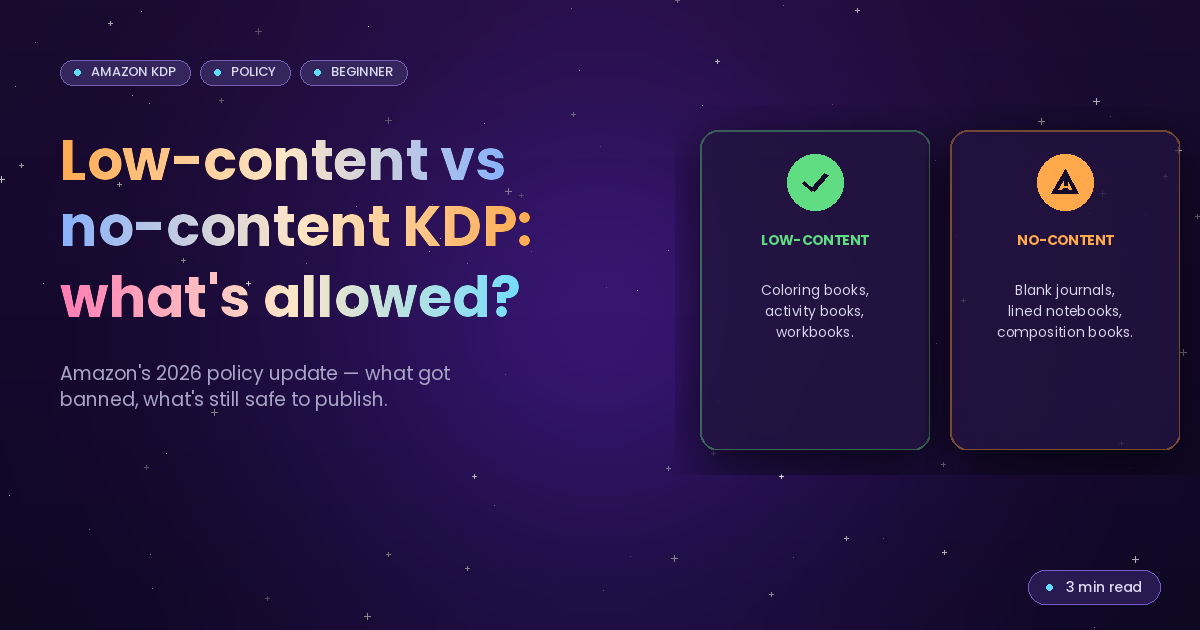
Amazon KDP has three content buckets for paperback books, and where your book sits determines what you can do with it, how you list it, and how fast it gets banned if you guess wrong. Here's the clear breakdown.
The three categories
1. No-content books
Books with zero or almost zero unique content. Blank journals, lined notebooks, plain grid notebooks.
- Amazon formally discouraged these in early 2024
- The "Not Low Content" toggle on the KDP listing page was added specifically to filter them out
- You can still publish them but they're largely invisible in search
2. Low-content books
Books that have a small amount of original content — repeating templates, structured prompts, simple formats.
- Examples: weekly planners, to-do lists with headers, graph-paper notebooks with chapter titles, gratitude journals
- Allowed on KDP, but heavily saturated
- Discoverability is poor unless your cover is truly exceptional
3. Full-content books
Books where every page is unique, meaningful content.
- Novels, cookbooks, how-to guides — obviously
- Coloring books — yes, every unique illustration counts as content
- Puzzle books (with unique puzzles), activity books with varied activities
Where coloring books sit
Coloring books with 20 unique illustrations are full-content books. This is a crucial distinction because:
- ✅ They rank in regular search (not filtered out)
- ✅ They can run Amazon Ads (the "Not Low Content" requirement)
- ✅ They qualify for A+ Content
- ✅ They can be enrolled in KDP Select for promotions
- ✅ You can use the category tools without restriction
Contrast with a generic "100 blank pages" journal, which:
- ❌ Is filtered out of many search results
- ❌ Cannot run ads
- ❌ Is often deranked below full-content books
This is the single biggest reason AI-generated coloring books are currently a more attractive business than AI-generated journals.
The 2026 policy update
In February 2026, Amazon quietly updated their content guidelines for KDP to emphasize that AI-generated content must still be "original" and "curated". Full text:
> Content generated using AI tools must be your own creative work. You are responsible for ensuring that the final product is of high quality, free of errors, and complies with our content guidelines.
For coloring books this means:
- Review every page before publishing — AI can generate weird anatomy, artifacts
- Curate, don't just submit — reject ~10-20% of generations that don't fit
- Don't publish duplicates — each book should have a genuine niche/audience focus
Sellers who ignore this and mass-publish have been getting account warnings. Sellers who curate thoughtfully are unaffected.
The 24-page KDP minimum trap
Amazon requires paperbacks to have at least 24 pages. Some sellers try to pad thin books with blank or divider pages to hit the minimum. This backfires because:
- Buyers complain in reviews ("mostly blank pages")
- Amazon may flag the listing as low-content
- Return rate skyrockets
Our recommended minimum: 40 pages total for a 20-illustration coloring book (20 illustrations + 20 blanks for single-sided printing). This hits the sweet spot of value + print cost.
Page count vs price strategy
| Pages | Illustrations | Retail $ | KDP royalty | Positioning | |---|---|---|---|---| | 40 | 20 | 4.99 | ~$1.20 | Budget-friendly, impulse buy | | 60 | 30 | 6.99 | ~$1.90 | Standard sweet spot | | 100 | 50 | 9.99 | ~$3.00 | Premium gift-giver | | 150+ | 75+ | 12.99 | ~$4.20 | Super-bundle, reviews-dependent |
40 pages at $6.99 is the most common winner — enough content to feel substantial, price tolerance for gift-giving, best margins per minute of production time.
What to put on the copyright page
Nothing complicated. Three lines:
Copyright © 2026 [Your Name]
All rights reserved.
Illustrations created with AI assistance.
That last line is honest, complies with the 2026 update, and doesn't spook buyers (AI-assisted is now normal — 2 million KDP coloring books openly state this).
Bottom line
If you're generating 20+ unique illustrations per book, you're making full-content books. Use KDP's full toolkit, check the "Not Low Content" box, and run ads when you have reviews. The category sits firmly on the right side of every Amazon policy line.
Next
Open /generate, pick a niche, make sure you're at 20+ keepers before assembling the PDF, and ship. The system is designed to land you firmly in the full-content category from page one.
Ready to ship your own book?
Try the AI generator free — bring your Gemini API key, pick a theme, get 20 pages in minutes.
Open the playground